
Small Reading Nook Ideas Start With a Good Lamp
Reading in bed or on the couch, and wishing you had a proper nook? Here’s what I’d buy and where I’d put it.
Some stores pay me when you buy through a link here, and your price stays the same. As an Amazon Associate I earn from qualifying purchases. How this works
The short answer
You don’t need a spare room for a nook, just the spot where you already read. I’d get the Birch Lane Theodora swing arm floor lamp, about $210 at Wayfair, because you can swing the shade in right beside you on the couch or in bed, and there’s no drilling.
The lamps
| Lamp | What decides it | Price |
|---|---|---|
| Birch Lane Theodora swing arm floor lamp By a couch |
17 in wide, 29 in deep overall | See price at Wayfair |
| Joss & Main Kevyn swing arm sconce Over a bed |
Reaches 24.25 in from the wall | See price at Wayfair |
| Glocusent LED neck reading light Someone’s asleep |
Hangs around your neck, with a warm 3,000K setting | See price at Amazon |
| Ebern Designs Liberty Hill clip-on lamp Story time |
Clips onto a headboard, with a dimmer switch | See price at Wayfair |
Then the books, and a chair
| Pick | What decides it | Price |
|---|---|---|
| Williston Forge Pingree floating shelves, set of 2 Books on the wall |
7.5 in deep, 36 in long | See price at Wayfair |
| Gracie Oaks Arshveer wingback chair A free corner |
27.75 in wide, plus 30 in clear on the side you walk past | See price at Wayfair |
My wife and I are both bookworms, and we’re hoping our daughter will be too. For now, we read to her on our bed or on the topper inside her playpen.
I usually read in bed too, or on our couch in the living room, and both spots are missing a good reading light. One corner of that room was meant to be our reading nook, until a relative gave us a nice massage chair that fit there perfectly.
We’re still planning to fix that corner, maybe with a lamp and some shelves on the wall for our books. If you came for the measurements, they’re at the bottom.
Do you read on the couch or in bed?
Then you’ve already got your seat, and all it needs is a light that reaches you.
On the couch
The Birch Lane Theodora’s arm swings out, so you can bring the shade in right beside your shoulder. It dims for the end of the night.
It does need a little floor of its own, so I’d give it the end of the couch, out of the walkway.
Where to buy the Theodora
WayfairViewAnd if there’s nowhere to set a cup down, the 17 Stories Keasha C-tables are about $54 for two at Wayfair. The C-shaped base is made to tuck over the arm of your couch, which puts your cup right at your elbow. (The second one’s for whoever has the other end.)
In bed
If your bed’s against a wall, I’d hang the light there. The Joss & Main Kevyn swing arm sconce reaches 24.25 in out from the wall, so the light comes to you.
It plugs in, cord included, so there’s no electrician to hire unless you’d rather hardwire it. I love that it leaves the whole nightstand for your book.
Where to buy the Kevyn
WayfairViewReading next to someone who’s already asleep? A lamp might be more light than you want. The Glocusent LED neck reading light hangs around your neck and throws a narrow beam onto the page, and Glocusent says it’s dim enough not to disturb a sleeping partner.
With one of its two heads on low, a charge lasts up to 80 hours, which is a lot of bedtime chapters. On its soft yellow setting, with any luck, nobody asks you to turn the light off.
Where to buy the Glocusent
AmazonViewHave a spare corner?
Start with the wall. Shelves don’t take an inch of floor, so they’re the easiest win in a small corner, and the chair can wait until you know there’s room.
Shelves for your books
Books get heavy fast, so I’d want real wood holding them up. I’d start with the Williston Forge Pingree, which is solid wood and rated for 50 lb. You get two shelves, each 36 in long, so there’s room for a good long row of spines.
If your books run big, I’d pick a deeper shelf. The 17 Stories Calheme is 10 in deep, against the Pingree’s 7.5 in, so your biggest books get more room to sit back from the edge.
For picture books, I’d go with a ledge. The Millwood Pines Darlicia stands them up with the covers facing out, though some shoppers found the color darker than pictured.
| Shelf | How deep | Price |
|---|---|---|
| Williston Forge Pingree, set of 2 | 7.5 in | See price at Wayfair |
| 17 Stories Calheme, set of 2 | 10 in | See price at Wayfair |
| Millwood Pines Darlicia ledge, set of 2 | 4.7 in | See price at Wayfair |
A chair, if the corner’s free
Our corner went to the massage chair, but if yours is still open, a narrow, upright chair is the easiest fit. The Gracie Oaks Arshveer wingback, about $347 at Wayfair, is 27.75 in across, and it slips in where a bulkier armchair would crowd the room.
It’s 33 in deep, so it does want that much floor plus walking room on the open side. Fit that, and shoppers say you get a comfortable seat.
Where to buy the Arshveer
WayfairViewSmall reclinersFor a reader who’d rather put their feet up
Reading to a little one?
For story time, a little clip-on lamp does the job. If yours happens in bed, clip one to the headboard.
The Ebern Designs Liberty Hill is about $33 at Wayfair. Its light is a cool white, at 5,000K, but the gooseneck keeps it on the page, and the dimmer lets you turn it low for the last story.
Where to buy the Liberty Hill
WayfairViewIf you ever build your little one a window seat, 16 to 18 in deep suits a kid better than the deeper seat a grown-up reads in.
Fingers crossed ours turns out a bookworm like her mom and dad.
Window seat cushionsWhat to sit on once it’s built
How much room does a small reading nook need?
Less than you’d think. A chair only needs walking room on the sides you actually walk past, so a corner does half the work for you.
The numbers
- Clear floor on a side you walk past: 30 in
- Hallway width, by residential code: at least 36 in
- Window seat depth for reading: 20 to 24 in
- Window seat height off the floor: 16 to 20 in
How much clear floor does a chair need?
30 in on each side you walk past.
Take the Arshveer. Tucked into a corner, it only needs a clear path on its open side, plus enough space in front to stand up out of it.
In a bedroom corner
If you’re planning a seat under a bedroom window, check first whether it’s the room’s emergency escape window. The window seat dimensions guide walks through what that means for the seat.
In a hallway or a windowless alcove
An alcove needs the least space, since three sides can be wall and only the open side needs walking room. A hallway’s harder, because residential code sets hallways at no less than 36 in wide, and a chair eats into that.
A windowless alcove is fine, too. The chair takes the same room either way, and you’d want a lamp regardless.
Beside a couch that can’t move
I’d put the chair at the end of the couch nearest the corner. Measure from that end to the wall, and take 30 in off for the walkway. What’s left is how much room the chair gets.
If you’re building a window seat
A window seat only saves floor where the wall already has a recess. Built out from a flat wall, it takes up room rather than saving any.
Without a seat back, you lean on the wall itself, so the cushions go behind you as well as under you. A built-in seat back runs 10 to 20 in tall, and the wall above it does the rest.
Where does the lamp go?
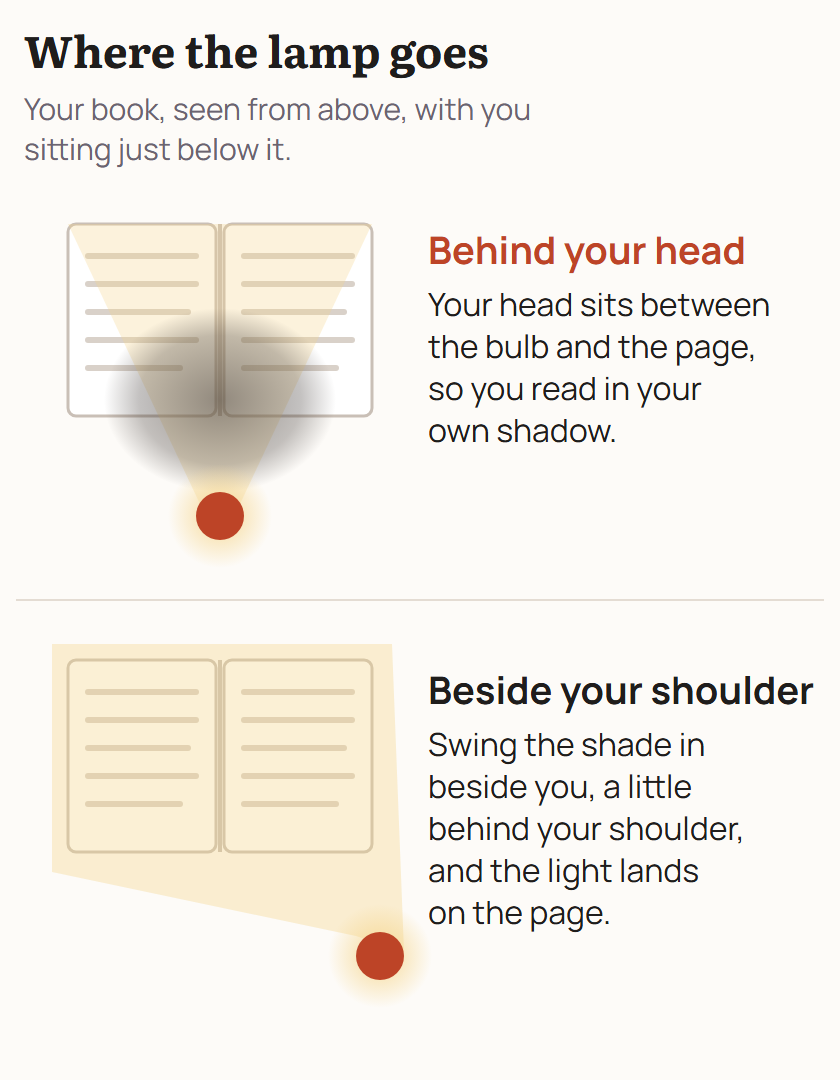
Beside you and a little behind your shoulder. Behind your head is the one spot that doesn’t work, because your head ends up between the bulb and the page and you read in your own shadow.
A window takes care of the daytime, and after dark it’s all up to the lamp.
Questions about small reading nooks
How much space do you need for a reading nook?
The chair at its widest, plus 30 in on each side you walk past and nothing on the sides against a wall. In a corner, that’s one or two sides instead of four.
Do you need a window for a reading nook?
No. A window only helps while it’s light out, and a good lamp covers the rest.
What chair works in a small reading nook?
A narrow, upright one, like the Arshveer wingback above. The chairs page puts six side by side if you’d like to compare.
Can you have a reading nook without a spare corner?
Yes. If you already read in bed or on the couch, a lamp that reaches you and a shelf on the wall make it a nook.
Sources (10)
- Dimensions.com, armchairs, read Aug 26, 2026
- Better Homes and Gardens, how to arrange furniture, read Aug 26, 2026
- Today’s Homeowner, window seat dimensions, read Aug 26, 2026
- This Old House, all about window seats (the 10 to 20 in seat back), read Aug 26, 2026
- IRC Section R311.6, hallways, read Aug 26, 2026
- IRC Section R310.2.2, sill height, read Aug 26, 2026
- Wayfair’s listings for the Birch Lane Theodora, Joss & Main Kevyn, Ebern Designs Liberty Hill and 17 Stories Keasha, with prices, stock, specs and Wayfair’s “Customers say” summaries, read Oct 13, 2026
- Wayfair’s listings for the Williston Forge Pingree, 17 Stories Calheme and Millwood Pines Darlicia, with prices, stock, specs and Wayfair’s “Customers say” summaries, read Oct 13, 2026. Wayfair gives one weight capacity per shelf listing and doesn’t say whether it’s per shelf or per set.
- Wayfair’s listing for the Gracie Oaks Arshveer, with price, stock and “Customers say” read Oct 13, 2026, and its Specifications block (27.75 in wide, which the listing title rounds to 27.5) read Sep 28, 2026
- Glocusent’s Amazon listing for the LED neck reading light, title and specs, including the brand’s line about a sleeping partner, read Oct 13, 2026
How these numbers get checked: methodology.